
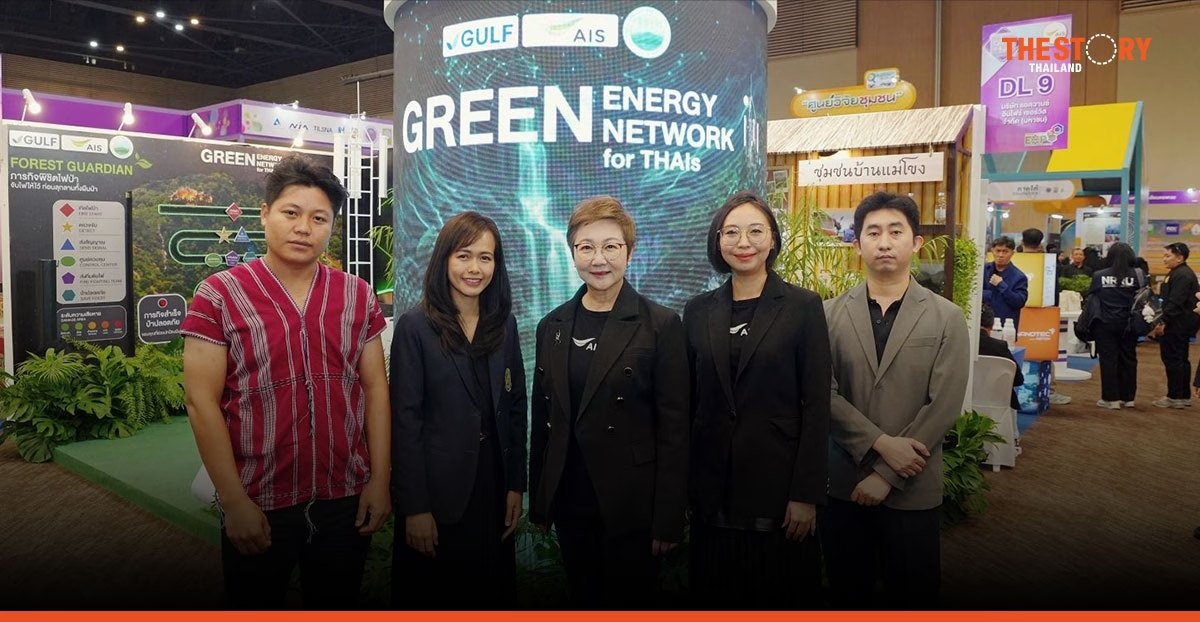
Advanced Info Service Public Company Limited (AIS) has announced the Social Return on Investment (SROI) results for its “Green Energy Green Network for THAIs” project at the Thailand Research Expo 2026. The event was organized by the National Research Council of Thailand (NRCT) under the Ministry of Higher Education, Science, Research and Innovation (MHESI). The study indicates that the project generated THB 33.88 million in social impact value from a THB 24.89 million investment, yielding a social return of 1.36 times. The data highlights how digital infrastructure and clean energy deliver economic, social, and quality-of-life advancements to underserved areas.
The initiative operates as a joint partnership between AIS, Gulf Development Public Company Limited (GULF), and the Highland Research and Development Institute (HRDI). By installing solar-powered telecommunications base stations in isolated regions, the project addresses systemic deficits in energy and communication infrastructure. The partners have maintained ongoing SROI research to systematically track long-term impacts and utilize the data to optimize future development strategies.
Multi-Dimensional Benefits Extended Across 5 Provinces
According to Saichon Submakudom, Chief Corporate Communication Officer at AIS, the project has transitioned remote locations from a total lack of electricity and connectivity toward digital integration, enabling access to education, healthcare, and digital income generation. The SROI study reveals that the initiative currently serves eight communities across five provinces: Chiang Mai, Chiang Rai, Mae Hong Son, Lamphun, and Tak. It encompasses over 3,520 individuals from 918 households, providing benefits in education, healthcare, local economic development, and environmental sustainability.
Field results demonstrate distinct community advancements:
- Ban Mae Khong (Chiang Mai): Residents utilized digital connectivity to market the Huai Nam Yen Waterfall online as an eco-tourism destination, generating over THB 2.5 million in economic value within a few months.
- Mokopoki (Tak): Local farmers bypassed geographical isolation by utilizing online channels to market agricultural products.
Furthermore, the integration of infrastructure has enabled remote communities to access e-learning platforms, digital libraries, telemedicine services, and emergency medical referral systems. It has also facilitated wildfire monitoring, disaster alerts, and localized emergency responses.
AIS plans to expand the utility of its telecommunications infrastructure by transforming mobile network towers into environmental and disaster monitoring stations. Future phases involve deploying AI-powered wildfire detection, real-time anomaly alerts, and meteorological monitoring tools. These integrations are designed to enhance data collection regarding weather conditions, PM2.5 dispersion, and drought risks to bolster environmental management and disaster preparedness.
Strategic Transition to Sustainable Development Goals
Saichon stated that organizational success is evaluated by community resilience and the expansion of opportunities rather than network reach alone. Moving forward, AIS intends to sustain cross-sector collaborations and utilize its research and technological assets to address social challenges, ensuring that digital infrastructure serves as a mechanism to improve quality of life and national sustainability.
Thailand drives regional AI Living Hub at Global Telecom AIoT Summit 2026
True, QTRic, and qBraid partner to build Thailand’s first Quantum AI hub