
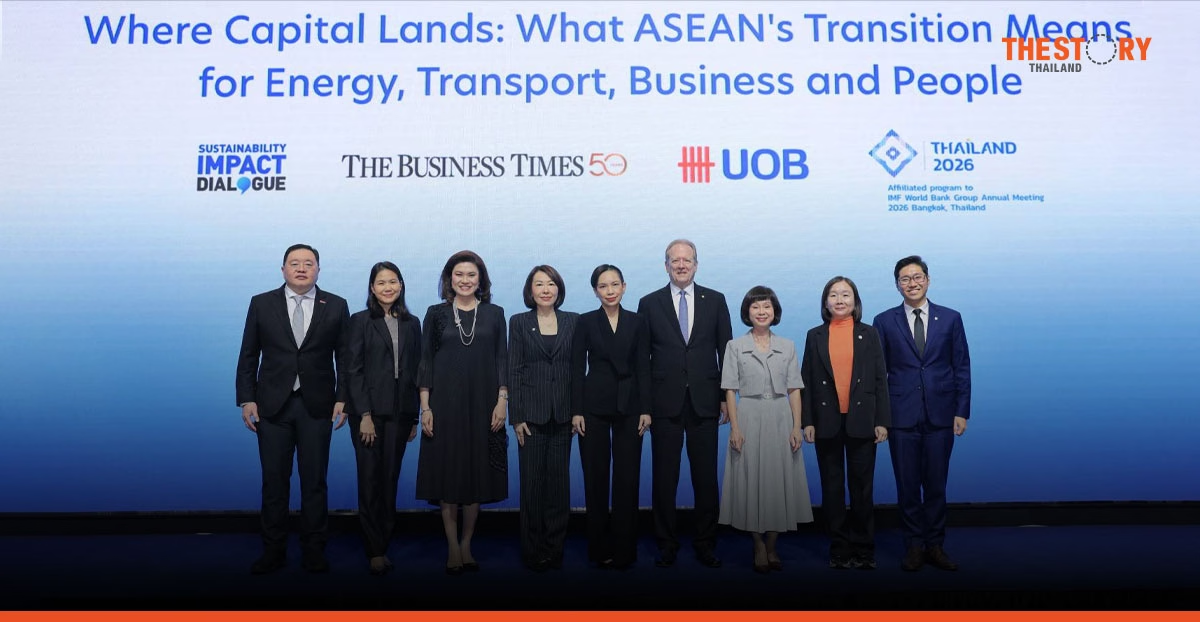
As ASEAN advances its sustainability transition, UOB Thailand and The Business Times jointly organized the “Sustainability Impact Dialogue – IMF-World Bank Group Annual Meetings 2026 Special Edition” on September 30, 2026, at UOB Plaza Bangkok.
Themed “Where Capital Lands: What ASEAN’s Transition Means for Energy, Transport, Business and People”, the affiliated program of the 2026 IMF-World Bank Group Annual Meetings brought together approximately 80 policymakers, business leaders, and sustainability practitioners. The event featured opening remarks by Chayawadee Chai-anant, Assistant Governor of the Bank of Thailand, followed by a fireside chat between Dr. Amy Khor, former Senior Minister of State for Sustainability and the Environment, and Transport, Singapore, and Chen Huifen, Editor of The Business Times.
A panel discussion moderated byChow Wong Yuen, Head of Financial Institutions and Chief Sustainability Officer at UOB Thailand, included Dr.Kirida Bhaopichitr, Thailand’s Vice-Minister for Commerce; Chompan Kulnides, Chief Sustainability Officer at Minor International; Thammasak Sethaudom, President and CEO of SCG; and Dr.Amy Khor.
Creating Conditions for Capital Flow
The dialogue highlighted that ASEAN’s sustainability transition is entering a pragmatic phase where capital availability must be matched with enabling conditions. Key requirements include policy and regulatory clarity, reliable data, enabling infrastructure, project readiness, and commercially viable pathways. These factors are critical for businesses facing upfront investment costs with long-term return horizons.
Chayawadee Chai-anant, Assistant Governor, International and Corporate Relations Strategy Group, Bank of Thailand, said: “Sustainability is increasingly becoming a competitiveness and resilience agenda for Thailand and ASEAN. As businesses navigate evolving market expectations, climate risks and transition requirements, capital can support practical solutions that strengthen resilience and long-term competitiveness. To do so effectively, we need the right foundations in place: common standards, reliable data and catalytic support, backed by strong collaboration across financial institutions, businesses and policymakers. This is how capital with purpose can reach where it is needed most and help scale solutions that deliver real impact.”
Public-Private Sector Collaboration
Discussions emphasized that collaboration across sectors is essential to address barriers and share risks. Governments provide policy certainty and regulatory frameworks, businesses drive operational innovation, and financial institutions connect transition plans with appropriate capital.
Richard Maloney, President and CEO of UOB Thailand, said: “Across ASEAN, the transition will ultimately be shaped by investment decisions being made every day by businesses. What matters is where capital lands, and whether the right conditions are in place to give investors the confidence to commit. This requires policy clarity, enabling infrastructure and commercially viable opportunities that can scale. We work closely with our clients and partners to connect credible transition plans with the expertise, partnerships and financing needed to turn ambition into action and build long-term resilience and competitiveness.”
Chen Huifen, Editor of The Business Times Singapore, added: “Forward-thinking cities and businesses understand that environmental resilience is directly tied to their long-term economic survival. By bringing together leaders from public policy and private capital, this dialogue serves as a platform to keep the sustainability drive going, break down geographic silos, and diffuse practical solutions throughout the region.”
AIS wins Autonomous Network Leadership Award for 4th year
GC and SCGC progress JV study, Targeting key terms by October 2026