
Economic growth in the ASEAN+3 region is forecast to hold steady at 4.0 percent in 2026 and 2027, even as ongoing conflicts in the Middle East and global energy supply disruptions threaten to stall momentum, according to a newly released report by AMRO.
In its annual ASEAN+3 Regional Economic Outlook (AREO) 2026, the organization noted that the region expanded by 4.3 percent in 2025. This figure surpassed the 3.8 percent projected following an April 2025 tariff shock, buoyed by domestic demand, AI-driven semiconductor exports, and stronger intraregional trade.
Despite this robust baseline, AMRO Chief Economist Dong He warned that Middle Eastern tensions have shifted economic risks downward. However, he emphasized that the region is better equipped to handle energy shocks than in previous cycles, citing improved energy efficiency, lower oil dependency, and manageable baseline inflation.
Headline inflation is forecast to rise incrementally, from 0.9 percent in 2025 to 1.4 percent in 2026, and 1.5 percent in 2027.
The report highlighted that the economic impact of the Middle East conflict will largely depend on its duration. A prolonged disruption could ripple beyond energy markets into logistics, food prices, remittances, and industrial inputs, with severity varying based on individual member states’ reliance on imported commodities and available policy buffers.
To counter potential stagflation as the global economy faces successive shocks, AMRO advised central banks to prioritize financial stability and respond decisively if supply constraints drive sustained inflation. The organization also urged governments to deploy targeted fiscal support for vulnerable demographics rather than broad-based measures that could undermine public finances.
Underpinning the region’s current resilience is a two-decade structural shift away from Western export reliance. The bloc’s share of value-added exports to the United States has fallen from roughly one-third to 20 percent, while intraregional absorption has grown to nearly 30 percent.
ASEAN+3 now represents 28 percent of global final demand, making it the world’s largest market. He described the traditional perception of the region as merely the “world’s factory” as increasingly outdated, stressing that deeper regional cooperation, open trade, and green transition efforts will be vital for sustaining this economic independence.
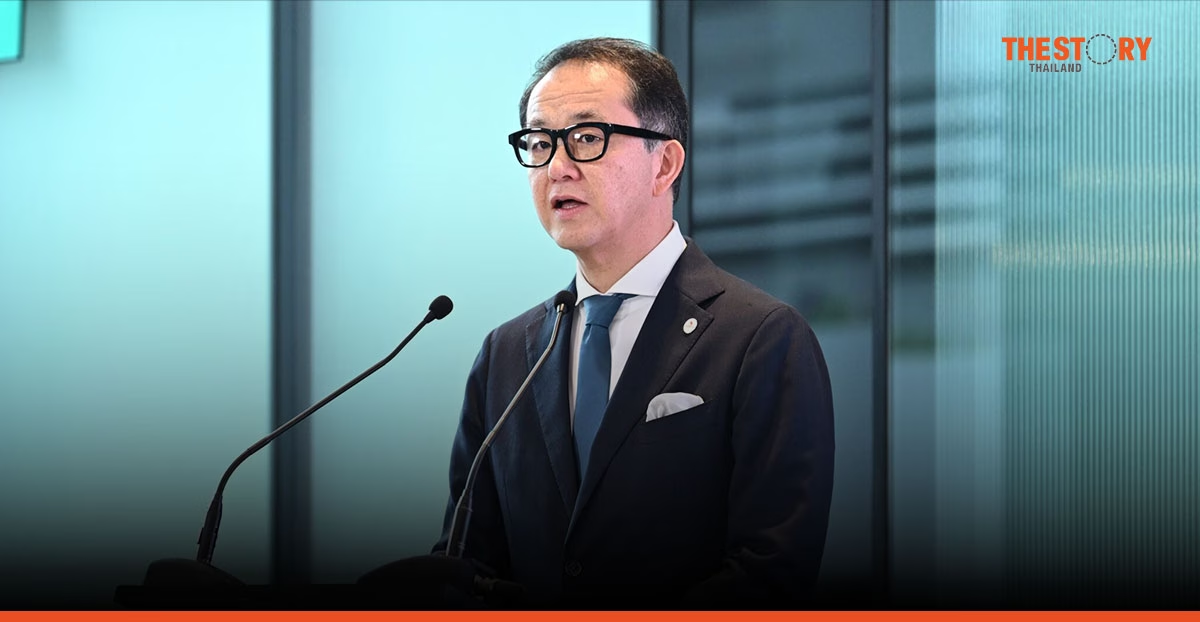
The full AREO 2026 report and statements regarding recent global developments from AMRO Director Yasuto Watanabe are available via the organization’s official channels.
APM 2026: Record Success Sets Sail for Next-Gen Energy & AI Innovation
Inside Agoda’s new ‘Silicon Valley of Bangkok’
APJ Enterprise AI reality: Nutanix secures $250M AMD deal