
The investment market enters the fourth quarter of 2026 supported by resilient corporate earnings and economic fundamentals. However, upside potential remains constrained following recent asset rallies, while prolonged geopolitical conflict, elevated oil prices, high interest rates, and rising bond yields exert increasing pressure on global financial markets.
InnovestX maintains that investment opportunities persist in Q4 2026, though heightened caution is necessary. With volatility remaining elevated and upside momentum limited, the recommended strategy centers on stock selection, focusing on fundamentals, avoiding price chasing, and diversifying portfolio risks.
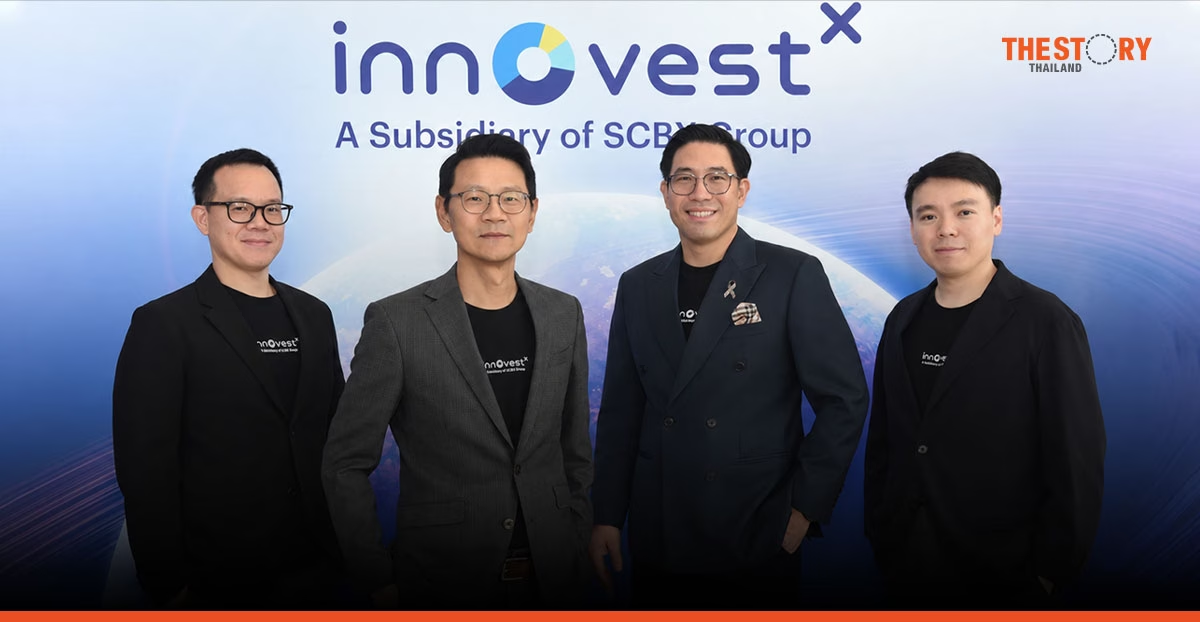
Sutthichai Kumworachai, Head of Investment Strategy & Research at InnovestX, stated that corporate earnings growth remains a core support for the market, particularly globally in AI and infrastructure-related sectors. Meanwhile, the Thai equity market receives backing from multiple domestic sectors.
However, third-quarter dynamics signaled rising market volatility. Foreign investors shifted back to net selling after temporary inflows earlier in the quarter, while major central banks resumed interest rate hikes, signaling the need for greater investment caution for the remainder of the year.
Geopolitical Conflict Signals Chain of Risk to Rates and Currencies
Key risks operate through interconnected channels, starting with the prolonged US-Iran conflict that keeps oil prices elevated, subsequently feeding into inflation, interest rate trajectories, financing costs, and the Thai baht.
InnovestX notes that this risk chain could reverse should geopolitical tensions ease and transit through the Strait of Hormuz normalize. Nonetheless, while uncertainty persists, investors must monitor multiple key variables simultaneously, including oil prices, bond yields, public debt, political and election developments, severe El Niño conditions, corporate earnings growth, and AI demand.
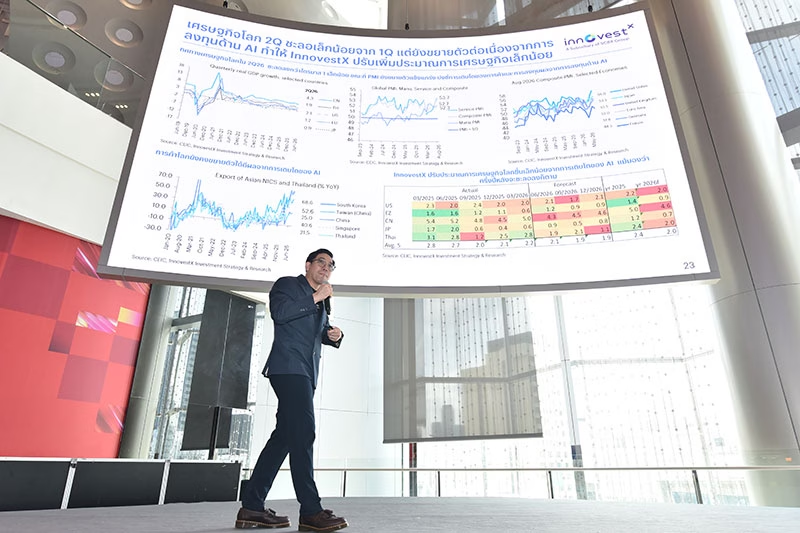
Dr.Piyasak Manason, Head of Economic Research at InnovestX, noted that despite rising interest rates, the global economy demonstrates resilience, backed by investments in AI, infrastructure, semiconductors, and data centers.
A key pressure point is rising bond yields, driven by government fiscal spending and increased debt issuance, which pushes up corporate financing costs. Prolonged high yields and tight monetary conditions could eventually slow economic growth and investment.
InnovestX raised its average oil price assumptions for 2026 and 2027 to US90andUS80 per barrel, respectively, while anticipating Thai baht weakness and persistent central bank monetary tightness.
Thai GDP Forecast Maintained at 2.0% for 2026–2027
For the Thai economy, InnovestX maintains its GDP growth forecasts for 2026 and 2027 at 2.0%, despite recent flooding in Bangkok. The impact is evaluated as limited and concentrated in Q3, as the flooding stems from heavy local rainfall rather than northern runoff, with government relief measures expected to cushion the economic impact.
Thailand’s economic trajectory continues to follow a K-shaped recovery. Private investment and exports driven by the AI cycle serve as primary drivers in 2026, before growth shifts toward public sector spending and private consumption in 2027.
On monetary policy, Thai interest rates are expected to hold near 1.0%. Divergence from major central banks that face rate hike pressures contributes to ongoing depreciation pressure on the Thai baht.
Corporate Earnings Support Market, but Price Chasing Cautioned
With no immediate global recession and positive corporate earnings growth, equity markets retain fundamental support, although investment conditions have become more demanding.
Sittichai Duangrattanachaya, Head of Investment Strategy at InnovestX, noted that earnings revisions for Thai listed companies—especially in the energy sector—have been trending upward. Globally, earnings growth is broadening beyond the technology sector into other industries.
However, upside potential remains capped after market gains, alongside risks from energy prices, inflation, monetary policy, financing costs, El Niño, and semiconductor pricing. InnovestX advises against price chasing, recommending that investors wait for suitable entry points.
InnovestX sets its 2027 SET Index target at 1,715 points, viewing 1,550 points as an attractive level to begin gradual accumulation. Top Thai stock picks include AMATA, CENTEL, CRC, KTB, and PR9.
For global equities, InnovestX favors AI beneficiaries including Google, Amazon, Nvidia, Tencent, and Alibaba, alongside semiconductor bottleneck firms and Chinese domestic chipmakers (Lumentum, Naura, SMIC, Biren). Defensive global names (HKEX, Visa, AIA, Walmart, Iberdrola, China Mobile) and dividend-paying stocks (Verizon, AXA, Enel, ICBC, HSHD23) are also recommended to ensure portfolio balance.
Portfolio Diversification Away from Heavy Tech Concentration
In a volatile market, asset allocation and portfolio structure are critical, particularly for investors with heavy exposure to technology stocks or the S&P 500.
Jaranapong Rattanasopa, Head of Investment Product Specialist at InnovestX, suggests building long-term portfolios across core holdings, defensive dividend-generating assets, and growth plays. Quality dividend stocks offer a practical tool to diversify away from tech concentration.
InnovestX highlights funds such as M-SCHD (investing via Schwab U.S. Dividend Equity ETF), which holds less than 10% tech exposure compared to nearly 40% in the S&P 500, and maintains a low correlation of 0.3 with the index. Additional long-term options offered include M-SCHG (Schwab U.S. Large-Cap Growth ETF) and Depositary Receipts referencing BlackRock iShares ETFs (IVV23, IQQ23, and SOXX23).
Diversifying into dividend assets does not imply exiting technology entirely, as AI demand remains strong. Rather, broadening earnings growth across sectors offers investors opportunities to balance portfolio risk.
Selective Investment Strategy for Q4 2026
The fourth quarter presents a mix of fundamental tailwinds and macroeconomic headwinds. While economic growth, earnings resilience, and AI momentum support markets, geopolitical conflicts, high interest rates, elevated bond yields, and public debt impose limits.
Investment success in Q4 2026 relies on selectivity, evaluating corporate balance sheets, earnings clarity, valuations, and portfolio balance. InnovestX recommends avoiding price chasing, accumulating quality assets on dips, and aligning long-term portfolios with individual risk profiles and investment horizons.
GC and SCGC progress JV study, Targeting key terms by October 2026
Immigration Bureau launches ‘THIM’ App for Foreign Travelers