
Historically, our mental image of robotics has been tethered to factory assembly lines and industrial automation. However, the innovations showcased at BEYOND Expo 2026 at the Venetian Cotai Expo in Macau signal a definitive shift: robotics and Artificial Intelligence (AI) are rapidly migrating from industrial zones straight into our daily lives.
The most compelling aspect of this year’s expo wasn’t just the sheer leaps in technological capability. Rather, it was how the industry is splitting into two distinct philosophical paths: robots engineered to maximize productivity and replace human labor, versus AI designed to enhance quality of life and build empathetic, human-centric experiences.
The Story Thailand explores how these advancements are reshaping our lifestyles, labor structures, and our fundamental relationship with technology through the standout innovations from the event.
Tech with Empathy: Robots Designed for an Aging Society
Amid a rapidly growing global aging population, SOMO—an AI robotics brand by Shanghai-based Deyin Tech—presented a refreshing perspective. Instead of looking at technology purely through a utilitarian lens, they prioritize emotional experience, dignity, and how elderly users coexist with machines daily.
Crucially, SOMO aims to erase the stigma of traditional mobility aids, which often make users feel like a burden. Their robotic wheelchair borrows its design language from the automotive industry, resulting in a sleek, contemporary aesthetic that feels like a premium lifestyle product rather than medical equipment.
As China’s first brand dedicated exclusively to the silver economy, Deyin Tech is tackling three core pillars: nursing, social connection for seniors living alone, and mobility. The true highlight is an intuitive, conversational voice system tailored to feel warm and familiar, effectively bridging the digital divide for older adults.
The Humanoid Wars Heat Up: Former Tesla Engineers Launch ‘Matrix 3’
While SOMO represents the future of caregiving, the fierce competition in the humanoid robot market has officially become the new battleground for global tech giants focused on automating complex human labor.
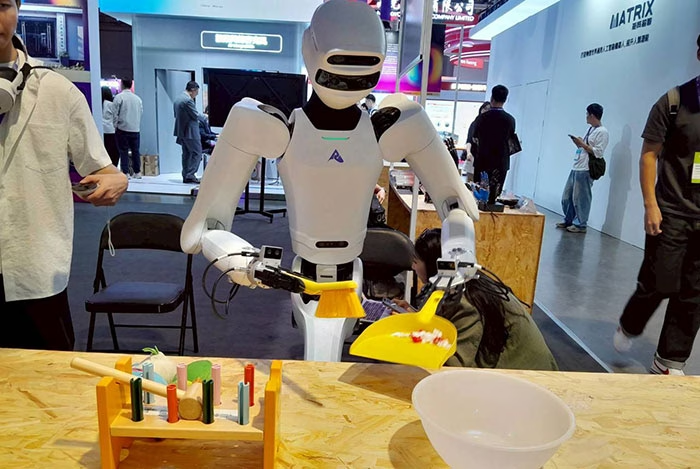
Matrix, a Shanghai-based startup, stole the spotlight by unveiling the Matrix 3—a humanoid robot positioned as a direct rival to Tesla’s Optimus. The hype is well-founded, given that over 50% of Matrix’s engineering team consists of former Tesla veterans who previously worked on high-profile advanced AI initiatives.
Equipped with 27 degrees of freedom (joints) in its hands alone, Matrix 3 can perform highly delicate tasks, from gripping fragile objects to brewing coffee. Priced initially at $80,000 USD, the company is first targeting B2B and government sectors for hospitality and reception roles. However, the ultimate goal is to scale into the consumer market within two years, allowing the robots to gather enough real-world data to handle complex domestic chores like cooking and grocery shopping.
The Revolution of Everyday Tasks: Specialized Robots Take Over
The broader picture from the expo makes one thing clear: robots are definitively moving from closed factories into commercial spaces and private homes through a wave of specialized machinery.

In the domestic sphere, OneRo by OneRobotics lives up to its tagline “Robotics for Real Living.” Their H1 model is a household humanoid driven by a Vision-Language-Action (VLA) model that continuously processes data to adapt to unpredictable home environments. Similarly, Astribot has mastered home tidying, while Galbot G1 specializes in brewing and serving coffee.
On the commercial and safety front, innovation is equally rapid. AI² Robotics introduced the AlphaBot Cube Service Solution, an “Intelligent Service Space” that integrates a humanoid robot into a dedicated cube environment to deliver seamless, face-to-face interactions. Meanwhile, Deep Robotics demonstrated advanced patrol and firefighting robots engineered for hazardous rescue missions.
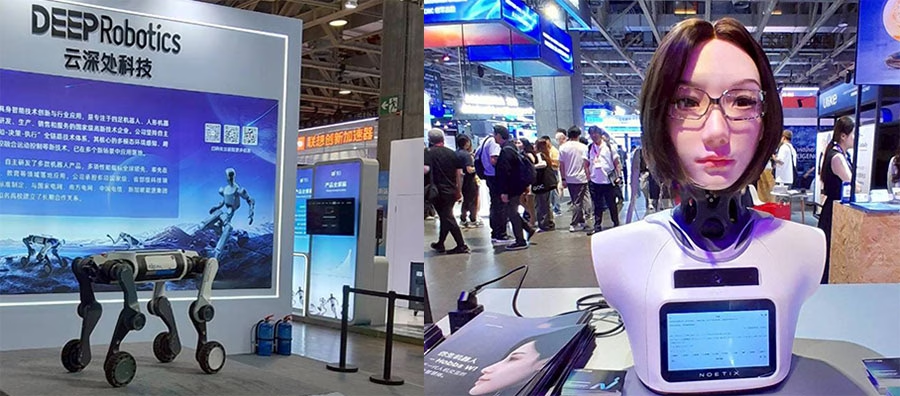
Even communication is becoming physical; NOETIX showcased Hobbs W1, the world’s first wheeled bionic robot. With 32 moving joints and a realistic Bionic Face, it breaks new ground by shifting from static screen communication to dynamic, expressive human-AI interaction.
The Question for Tomorrow
Looking at the big picture, these technologies represent a profound paradigm shift. AI is transitioning from an industrial optimization tool into personal assistants in our homes, service staff in our businesses, and guardians of public safety.
BEYOND Expo 2026 was a historical marker showing that AI and robotics are advancing down two parallel paths: maximizing economic productivity and learning to empathetically coexist with humans. As AI masters how to work for us, care for us, and talk to us, the ultimate question is no longer “How much smarter can these robots get?” but rather: “What role do we actually want them to play in our lives?”