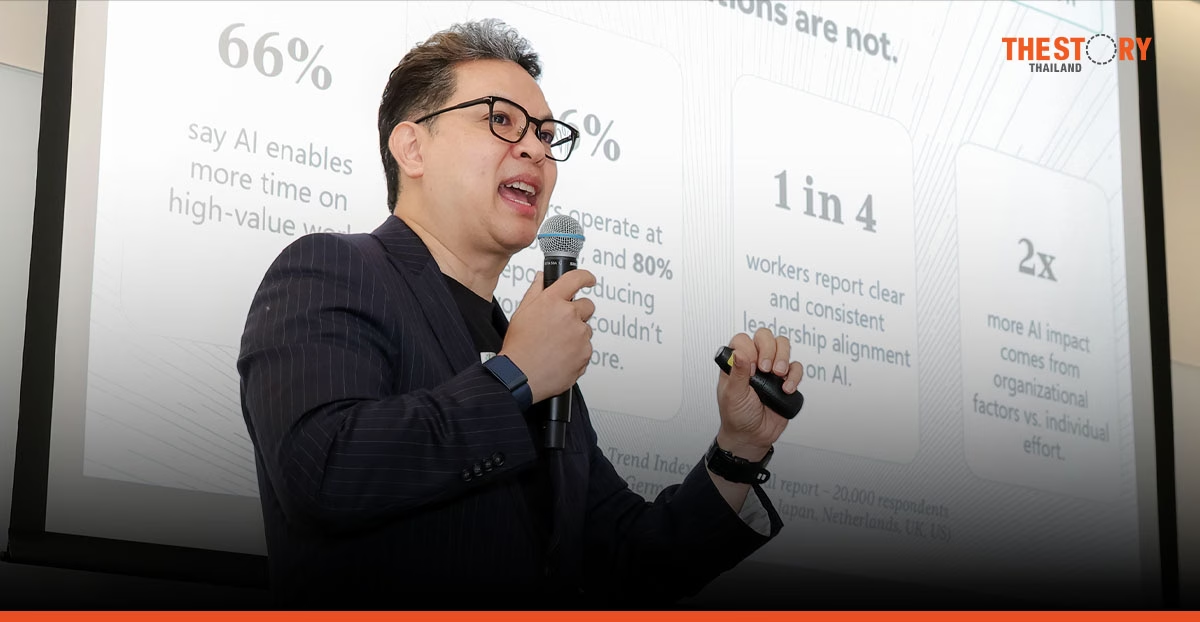
Microsoft has released key findings from its Work Trend Index 2026, revealing that 32% of Thailand’s workforce is classified as “Frontier Professionals” (advanced AI users)—double the 16% global average. Despite this high individual adoption, most Thai organizations struggle to integrate AI into core workflows. Microsoft recommends adopting a “Human Agency” approach by deploying AI agents under human supervision to handle operational tasks, enabling employees to focus on critical thinking, quality control, and strategic decision-making. This shift aims to build “Owned Intelligence”—transforming individual knowledge into proprietary organizational capabilities.
The Work Trend Index 2026 synthesized behavioral data from Microsoft 365 with a survey of 20,000 AI users across 10 global markets, including Thailand. The study shows AI shifting from a basic search tool to a strategic co-pilot. Globally, 49% of Microsoft Copilot usage supports cognitive tasks such as analyzing, reasoning, and deciding, with 28% focused on problem-solving and high-value decision-making.
In Thailand, employees have widely adopted AI to enhance daily tasks. According to the report, 89% of Thai workers use AI outputs as a starting point to refine their own ideas, while 86% of Thai Frontier Professionals state AI allows them to produce work that was previously impossible. However, Thai workers score relatively low in key analytical skills compared to Southeast Asian peers:
- Quality Control of AI Outputs: 53% of Thai workers deem quality control vital, ranking 5th out of 6 regional markets (behind Indonesia and Vietnam at 60%).
- Critical Thinking: 45% of Thai workers recognize critical thinking as essential when working with AI, ranking lowest in Southeast Asia (compared to 65% in the Philippines and 62% in Indonesia).
On the organizational side, global data indicates that factors like culture, leadership, and talent development exert twice the influence on AI success compared to individual effort. In Thailand, structural gaps remain pronounced:
- Visionary Leadership Lacking Tangible Support: While 51% of Thai employees state their leaders communicate a clear AI direction (above the 26% global average), only one-third of Thai leaders actively reward AI experimentation without expecting immediate results.
- The Transformation Paradox: Although 85% of Thai employees fear falling behind without AI (versus 65% globally), 60% prefer sticking to existing routines due to the risks of altering workflows without a structured plan.
- Undocumented Innovation: While 80% of Thai managers encourage AI experimentation, only 20% of teams systematically document successful trials into standardized workflows, causing best practices to remain isolated with individuals.

Dhanawat Suthumpun, Managing Director of Microsoft Thailand and Emerging Markets, emphasized that the main challenge for Thai companies is redesigning workflows rather than just boosting individual productivity. He stated that leaders must identify which processes to transform and build collaborative models combining human potential with AI capabilities, turning fragmented knowledge into “Owned Intelligence.”
To bridge the gap and become “Frontier Firms,” Microsoft recommends a three-tiered roadmap:
- Employees: Build critical thinking and quality control skills while experimenting daily.
- Leaders: Embed AI experimentation into core job responsibilities and provide necessary time and resources.
- Organizations: Track internal AI usage to redesign workflows around a Learning System, maintained within strong safety, transparency, and governance frameworks.
Leading Thai Organizations Share Transformation Journeys
At the event, executive representatives from prominent Thai organizations shared their AI transformation strategies.
Dr.Tiravat Assavapokee, Executive Vice President of Kasikornbank Public Company Limited (KBank), shared, “KBank’s AI strategy is built on two mutually reinforcing pillars: empowering every employee with self-service AI tools to work smarter, and scaling organizational capabilities. This includes internal knowledge management, intelligent recommendations, and operational intelligence to elevate experiences for both our employees and customers at scale.”
Akkarin Phureesitr, Chief People Officer of Central Pattana Public Company Limited (CPN), said: “The future of work is people and AI growing together. At Central Pattana, our people are shifting from doers to thinkers and decision-makers, with AI amplifying their potential. But matters of people must always be decided by people. This transformation begins with people and ends with people – and we’ll step into that future together.”
Palo Alto Networks: Machine Identities Outnumber Humans 111:1 in APAC
Sigve Brekke leads True Alpha 2026, Turning intern AI ideas into business value