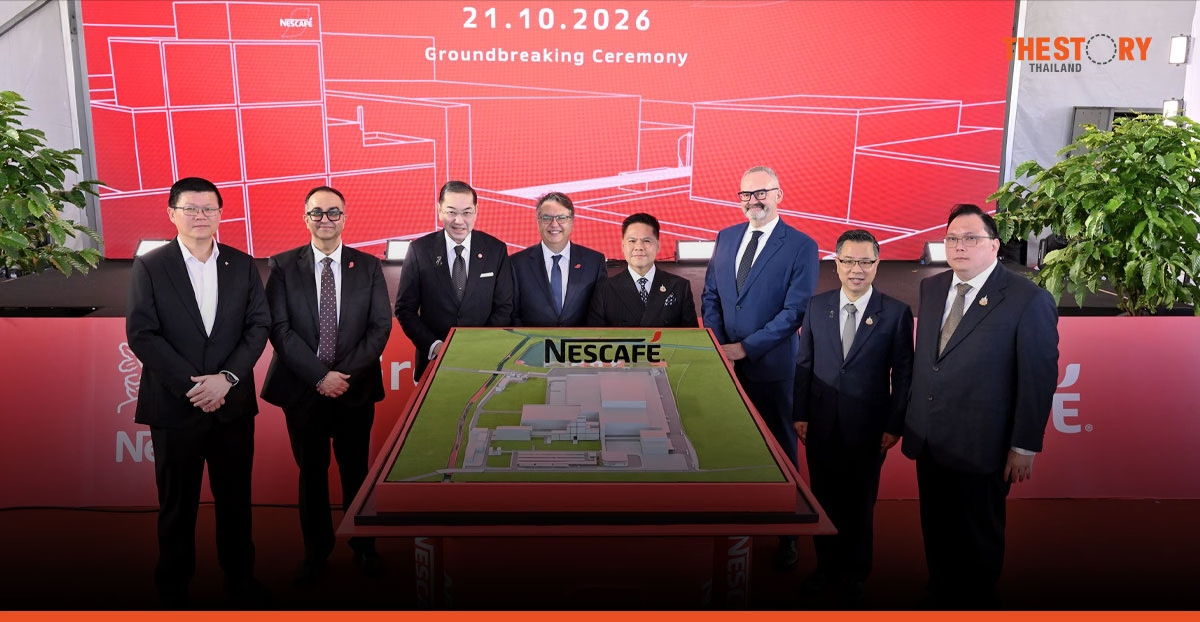
Nestlé has begun construction of a THB 23 billion coffee factory in Thailand to meet growing consumer demand and expand production capacity in Southeast Asia. The House of NESCAFÉ Thailand facility, located at the Araya Industrial Estate in Samut Prakan province, is expected to begin operations in late 2028. The project will include an on-site distribution center and a Coffee Innovation Center, create more than 500 jobs and source approximately THB4.3 billion in local ingredients and raw materials annually from Thai farmers and suppliers.
Expanding capacity in a key coffee market
Remy Ejel, Executive Vice President and CEO of Nestlé’s Zone Asia, Oceania and Africa, said coffee is Nestlé’s largest business globally and Thailand is one of its largest and most dynamic coffee markets. NESCAFÉ is the country’s No. 1 coffee brand, he said. The investment will help the company meet rising consumer demand, expand production capacity in Southeast Asia and support long-term growth in its coffee business, while reinforcing its commitment to Thailand and the country’s coffee sector.
The factory will produce a range of NESCAFÉ products, including soluble coffee, coffee mixes and ready-to-drink coffee beverages, serving consumers at home, on the go and out of home. Nestlé said the portfolio would combine quality, affordability and product innovation. The planned Coffee Innovation Center will develop high-quality ingredients, inspire new recipes and drive product innovation, with the aim of supporting the development of Thailand’s coffee industry.
AI and automation connect production and distribution
The facility is set to become one of Nestlé’s most advanced coffee production sites worldwide, using the company’s latest proprietary coffee extraction and aroma recovery technologies alongside artificial intelligence, robotics and automation. Its on-site distribution center will handle products across multiple Nestlé categories, connecting production, automated storage, order picking and dispatch in real time. An automated storage and retrieval system will accommodate more than 100,000 pallets, while AI-driven systems and automation will coordinate operations to improve quality, efficiency and sustainability.
Local sourcing to reach THB4.3 billion annually
The factory will source approximately THB 4.3 billion in local ingredients and raw materials each year, including coffee beans, sugar and fresh milk. Nikhil Chand, Chairman and CEO of Nestlé Indochina, said the project would create long-term value for Thailand’s economy and society through local employment and purchases from Thai farmers and suppliers, alongside manufacturing products for Thai consumers. The more than 500 jobs will include technology specialists and other mid- and highly skilled positions, with employees given opportunities to develop their capabilities in advanced technologies.
Nestlé said it has been a major buyer of Thai robusta coffee beans for more than 40 years. Its support for growers includes knowledge-sharing, the distribution of high-quality coffee plantlets and efforts to expand cultivation across several regions of Thailand. Sourcing for the new facility will continue the company’s work with local farmers and suppliers as it develops its coffee manufacturing operations in the country.
Renewable electricity and zero-landfill targets
The facility aims to reduce carbon emissions through the use of 100% renewable electricity, biomass fuel, heat recovery and other technologies. It is also designed to achieve zero waste to landfill and will incorporate a water recycling system. These measures form part of the project’s sustainability plans, alongside the use of advanced manufacturing and distribution systems to improve operational efficiency.
Government backs investment and skills development
Varawut Silpa-archa, Minister of Industry and Vice Chairman of the Thailand Board of Investment, said the project demonstrated Thailand’s readiness to welcome investment and facilitate business. He reaffirmed government support for responsible investors that bring advanced technology to the country, develop workforce skills and respect the environment, describing the new factory as an example of cooperation between a global company and the Thai government.
Betagro acquires a majority stake in Freshket
Meta unveils Business AI on Messenger in Thailand
AI fuels Buzzebees growth, defying market trends