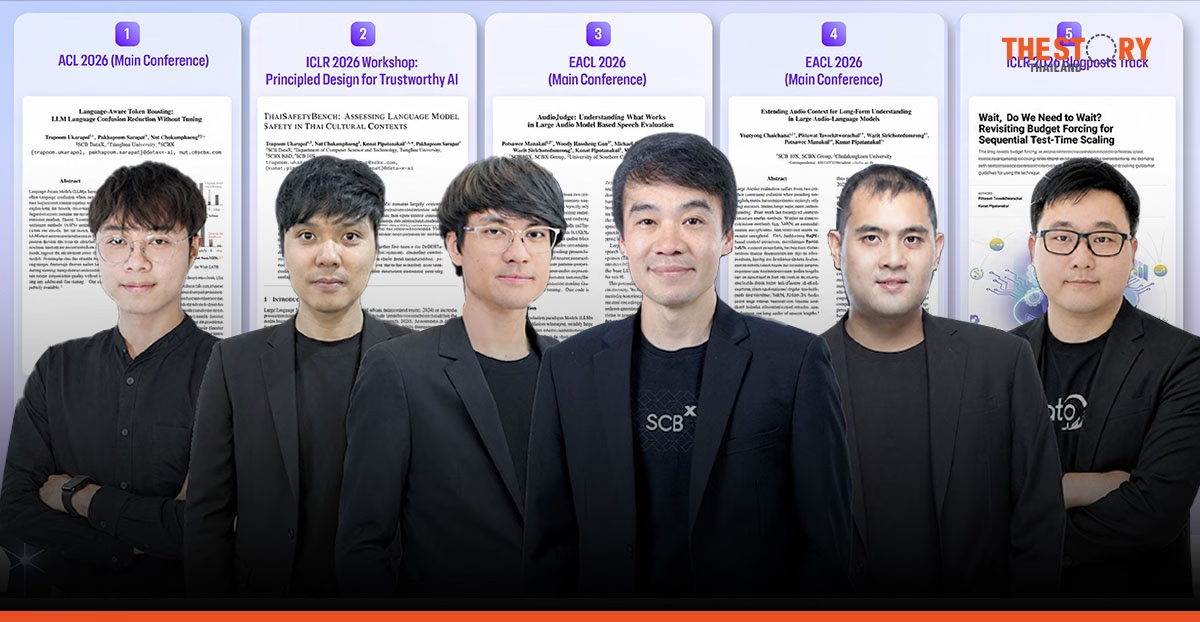
SCBX Group has announced that five of its research papers have been accepted for presentation across four major global academic AI conferences in 2026: ACL (Main Conference), EACL (Main Conference), the ICLR Workshop on Principled Design for Trustworthy AI, and the ICLR Blogposts Track.
This achievement is a collaborative result from internal research teams across the SCBX group, specifically SCBX and SCB DataX. The joint initiatives focus on three strategic pillars: enhancing the performance and safety of AI in Thai language and cultural contexts; developing audio-language capabilities for real-world applications; and deepening foundational research regarding large language model (LLM) reasoning. The conferences involved represent elite forums for Natural Language Processing (ACL and EACL) as well as machine learning and deep learning (ICLR).
Kaweewut Temphuwapat, Chief Innovation Officer of SCBX and Chief Executive Officer of SCB 10X, stated that these five papers highlight an AI development approach that addresses real-world usability in Thai language contexts, system-level safety, and foundational research. These elements are essential for deploying AI in high-trust sectors like financial services. He added that the group remains committed to an open research approach to build capabilities within Thailand’s AI ecosystem.
The specific details of the five accepted research contributions are as follows:
1) Language-Aware Token Boosting (LATB)
The paper accepted to ACL 2026 (Main Conference) introduces a novel technique, Language-Aware Token Boosting (LATB), designed to address a common challenge in Thai-language LLM usage—language drift, where models respond in English or mix languages despite prompts being in Thai, resulting in an unnatural user experience.
LATB significantly mitigates this issue without requiring additional model fine-tuning, reducing both computational cost and development time, while enabling more efficient real-world deployment and a more consistent Thai-language user experience.
2) ThaiSafetyBench: Benchmarking AI Safety in Thai Contexts
The paper accepted to the ICLR 2026 Workshop, Principled Design for Trustworthy AI, introduces ThaiSafetyBench, a safety benchmark for large language models (LLMs) specifically designed for Thai language and cultural contexts.
Global AI safety evaluations today remain heavily reliant on English-centric benchmarks, leaving context-specific risks—such as those related to Thai social norms, cultural nuances, and local values—largely unexamined. As a result, organizations in Thailand lack standardized tools to assess whether AI systems are sufficiently safe for real-world deployment in Thai contexts.
ThaiSafetyBench addresses this gap with a dataset of 1,954 Thai-language test samples, covering six risk categories and 17 harm types. The research team evaluated more than 24 leading AI models, including Claude Sonnet 4.5, GPT-5, Gemini, Llama, Gemma, and Qwen, as well as locally developed models such as Typhoon and OpenThaiGPT.
The study finds that culturally contextualized attacks achieve significantly higher success rates than generic attacks, highlighting critical vulnerabilities in current AI systems that remain unresolved at the global level.
To support broader ecosystem development, the team has released the dataset, leaderboard, and a harmful content detection tool, ThaiSafetyClassifier, as open-source resources, enabling researchers and developers across Thailand to advance AI safety standards collaboratively.
3) AudioJudge: Unified Audio Evaluation Using Large Audio Models
The paper accepted to EACL 2026 (Main Conference), led by the Typhoon team at SCB DataX, introduces AudioJudge, a framework that leverages large audio models (LAMs) as unified evaluators to assess multiple dimensions of speech simultaneously—including pronunciation, speaking rate, speaker identification, and audio quality—replacing the need for separate specialized systems.
The proposed multi-aspect ensemble AudioJudge achieves a Spearman correlation of up to 0.91, closely aligning with human judgment, marking a significant step toward developing evaluation systems that more accurately reflect human perception.
4) Extending Audio Context for Long-Form Understanding
Another paper from the Typhoon team (SCB DataX), accepted to EACL 2026 (Main Conference), tackles a key bottleneck in large audio-language models (LALMs), which are typically constrained by short audio input limits despite longer text context capabilities. The study introduces Partial YaRN, a modality-decoupled method for extending audio context without affecting text performance, alongside Virtual Longform Audio Training (VLAT), enabling models to generalize effectively to longer audio sequences. These advancements pave the way for real-world applications requiring long-form audio understanding, including meetings, call center operations, and large-scale audio content processing.
5) Wait, Do We Need to Wait? Revisiting Budget Forcing for Sequential Test-Time Scaling
The paper accepted to the ICLR 2026 Blogposts Track re-examines Budget Forcing, a technique for enhancing LLM reasoning by controlling “thinking budgets” and prompting continued reasoning with cues such as “Wait.” Through systematic evaluation across multiple model families—including Qwen, Llama, Gemma, and Mistral—the study finds that performance gains are non-linear, challenging prior assumptions, and that “Wait” is not consistently the most effective trigger. Instead, naturally frequent tokens such as “Let” or “Perhaps” often yield better results. The research provides practical guidelines for applying test-time scaling and offers new insights to the global AI research community.
Readers can access AI and FinTech insights, technology updates, and the latest content from the SCBX Knowledge Hub through the SCBX R&D LINE OA at: https://lin.ee/8dvXKVs.
NTT DATA integrates Cursor AI into global software engineering engine
SCBX leads regional digital finance, driving real-world tokenization