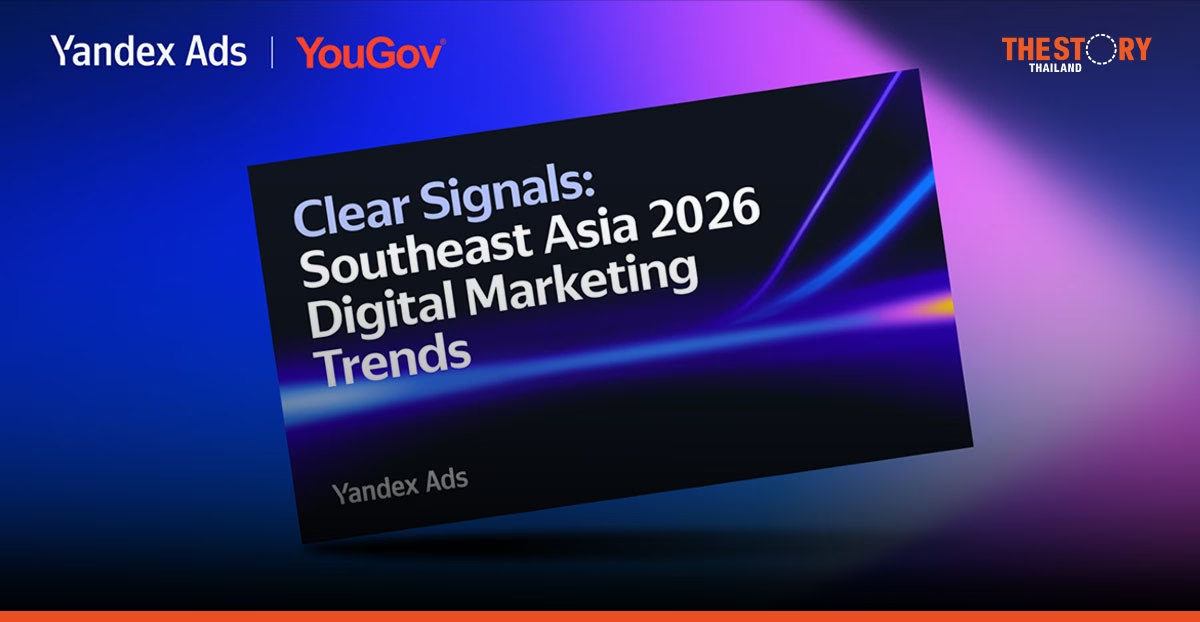
Thailand has been officially recognized as the leader of the AI-powered advertising boom in Southeast Asia, according to the newly released Yandex Ads x YouGov “Clear Signals: Southeast Asia 2026 Digital Marketing Trends Report.” The report, based on a survey of marketers across Thailand, Vietnam, and Indonesia, reveals that AI adoption in advertising is widespread throughout the region, with 77% of marketers either piloting or fully implementing AI solutions. Thailand leads regional adoption at 84%, placing it at the forefront of the AI-driven marketing transformation, followed by Vietnam and Indonesia. Across the region, 66% of marketers report that AI is already delivering a high or very high business impact.
However, adoption alone is no longer the defining factor for success. The report indicates that execution readiness has emerged as the true differentiator, with 79% of marketers identifying cost, lack of tools, or insufficient internal expertise as barriers to increasing their marketing spend. Concurrently, 80% of marketers now manage performance reporting in-house, escalating the pressure on teams to demonstrate measurable outcomes before budgets are unlocked.
The data suggests that marketers are transitioning away from fragmented, tool-based experimentation toward integrated, AI-driven ecosystems. These ecosystems are capable of automating optimization, enhancing audience relevance, adapting creatives, and managing measurement across channels. As pressure grows to prove return on investment (ROI), platforms powered by recommendation technologies and machine learning are becoming vital for automating optimization, improving audience relevance, and scaling performance across channels.
Performance Concentrates in Fewer Formats as Experimentation Slows
Faced with rising pressure to deliver proven results, marketers are consolidating their budgets around a smaller group of established formats. Despite this trend, Thailand remains comfortable maintaining a presence across saturated and secondary ad formats rather than retreating to a narrow mix, with social media ads at 63% and video at 55%. Marketer confidence remains strong beyond the top formats: influencer marketing stands at 48%, display ads at 34%, and native advertising at 32%. This flatter distribution points to a higher tolerance for format diversification within competitive media environments.
Mobile Remains the Center of Strategy But Precision Drives Success
Mobile-first platforms continue to anchor media planning across Southeast Asia, with 71% of marketers citing social media ads on mobile platforms as their primary route to customers. Nevertheless, the report notes growing friction in execution. Within short-form video—one of the most optimization-intensive mobile formats—a lack of audience insight (28%) was identified as a primary barrier to maximizing performance, limiting the ability of marketers to fully capitalize on the format’s potential.
Markets Scale at Different Speeds Depending on ROI Confidence
While belief in the impact of AI remains high throughout Southeast Asia, the velocity at which markets transition from pilot programs to full-scale implementation varies significantly. The proportion of marketers citing difficulties in measuring ROI ranges from 41% in Vietnam, 23% in Thailand, to 14% in Indonesia. These variances demonstrate that decision confidence, rather than adoption levels alone, is increasingly influencing how quickly marketing budgets expand.
International Growth Rises, But Cost and Localization Reshape Execution
International expansion is a priority for Southeast Asian advertisers. While 66% of marketers maintain their focus on APAC markets, interest is steadily growing in Europe/EMEA (47%) and CIS/Russian-speaking (22% ) markets. Businesses are looking past saturated domestic competition toward regions characterized by strong consumer spending, lower acquisition pressure, and high long-term growth potential.
However, cross-border expansion has become more deliberate as marketers carefully weigh execution risks against opportunities. The most frequently cited challenges in targeting international audiences include cost and budget constraints (46%), a lack of actionable insights (38%), difficulty measuring ROI (35%), and localization complexity (35%).
Among advertisers specifically targeting CIS/Russian-speaking markets, structural readiness plays a more prominent role. These advertisers are more likely to prioritize digitalization and omnichannel delivery (50% vs. 36% overall) and localization (36% vs. 24% overall). They also place a stronger emphasis on utilizing first-party data (41% vs. 31%) and personalization (39% vs. 28%).
Industry Perspectives
Neha Dawar, Business Development Manager at Yandex Ads Thailand, commented on the findings, stating that Thailand’s landscape is defined by a highly platform-driven and mobile-first ecosystem where digital platforms dictate how consumers discover and engage with content. She noted that while this provides a strong foundation for AI to deliver an impact, it requires alignment with the right data, tools, and executional capabilities. Dawar urged Thai marketers to move beyond experimentation to focus on audience understanding, cross-platform data integration, and performance-driven AI applications, highlighting that Yandex Ads’ platform helps businesses deliver tangible results by unifying data and investing in performance-driven approaches.
Paruj Daorai, DAAT Committee member of the Digital Advertising Association (Thailand), remarked that the report provides crucial insights for the industry. He emphasized that marketers must shift from being simple tool users to strategic decision-makers to avoid being driven solely by technology. Daorai also noted that AI is acting as a key intermediary connecting brands and consumers for efficient content creation and distribution, while consumers simultaneously use AI to filter content. He stated that the modern challenge centers on developing strategies that intelligently integrate technology, human understanding, and data for sustainable growth.
Thienprasit Chaiyapatranun, President of the Thai Hotels Association (THA), added that expansion into these international regions represents a deliberate strategic move as demand patterns diversify and reliance on single-source markets decreases. He explained that slower growth and rising competition within core APAC routes are coinciding with shifts in global mobility, including a surge in Russian-speaking travelers driven by visa-free access. According to Chaiyapatranun, these audiences bring distinct expectations, such as longer planning cycles, a heavier reliance on trust and service details, and stronger engagement with search, long-form video, and messaging-led discovery rather than impulse-driven social feeds.
The complete report can be downloaded via the official link: https://ads.yandex.com/newsroom/news/yandex-ads-yougov
THAIFEX – Anuga Asia 2026 to debut next-gen food and sustainable packaging innovations
True activates 24-hour AI War Room for ‘Thai Chuay Thai Plus’ surge