Banpu is reshaping its energy portfolio following its amalgamation with Banpu Power (BPP), positioning the combined business to capture rising electricity demand from artificial intelligence, cloud computing and large-scale data centres while expanding across gas, power, strategic minerals and future energy technologies.
The Thai energy company is moving forward with its “Energy Symphonics” strategy, bringing together energy resources, infrastructure and solutions across the Asia-Pacific region and the United States. The strategy is built around four core business pillars — U.S. Closed-Loop Gas, Next-Gen Mining, Power+ and Future Tech — as Banpu seeks to strengthen its position across the energy value chain.
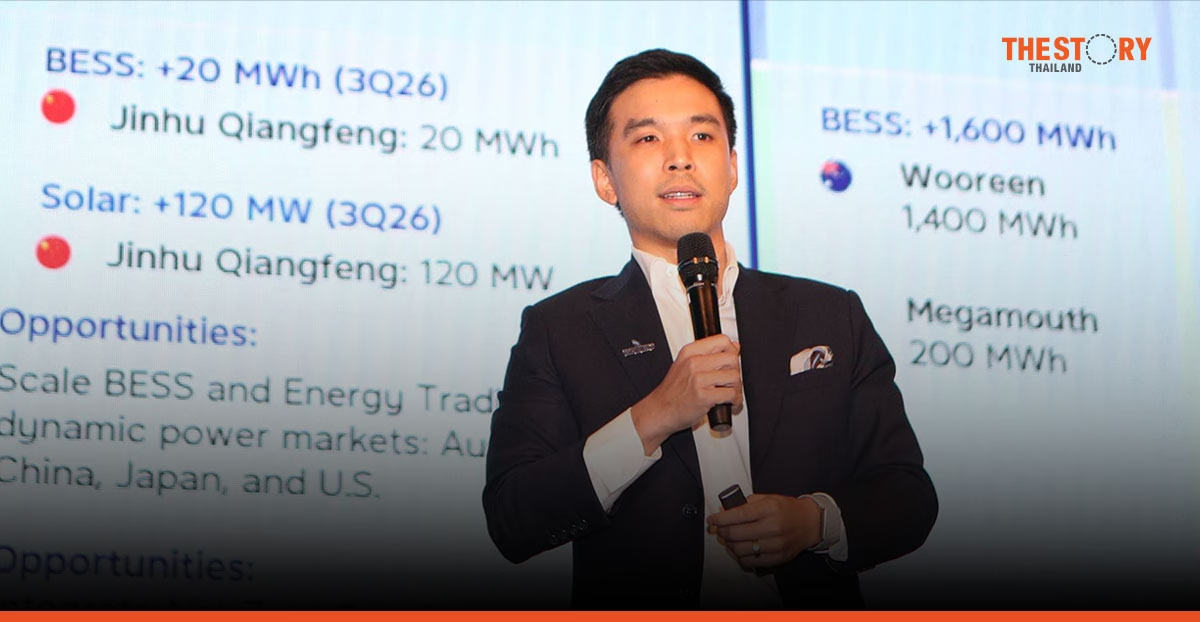
Sinon Vongkusolkit, chief executive officer of Banpu Public Company Limited, said the company was entering a new phase of growth with a business spanning the energy value chain from upstream to downstream.
“Today, Banpu is entering a new chapter of strong growth with an energy business that spans the entire value chain from upstream to downstream,” Sinon said.
He said Banpu’s presence in markets at the forefront of energy growth and technological development, combined with rising demand from energy-intensive hyperscalers, placed the company in a strong position to create value for the global energy industry, businesses seeking reliable and responsible energy, and shareholders.
Gas-to-Power targets hyperscaler demand
Under its U.S. Closed-Loop Gas business, Banpu plans to leverage an integrated gas-to-power platform as it increases natural gas production and explores opportunities to supply electricity to technology infrastructure.
Natural gas production is targeted at approximately 960 million cubic feet equivalent per day in 2026, up from 836 Mmcfed in the previous year. The business already has 1.5 gigawatts of power generation capacity through the Temple I and Temple II gas-fired power plants.
Banpu is also considering the development of a new energy complex in Jack County, Texas, on a 6,000-acre site with access to high-capacity transmission infrastructure and gas pipelines.
The company is incorporating Carbon Capture, Utilization and Sequestration technology into the platform. Through BKV, it is targeting CO2-equivalent injection of 1.5 million metric tonnes annually by 2028.
At the same time, Banpu plans to pursue long-term power purchase agreements to serve technology infrastructure providers, cloud computing operators and hyperscale data centres, linking its gas and power assets more directly with the rapidly expanding digital economy.
Mining pivots to strategic minerals
Banpu’s Next-Gen Mining business will continue to build on its upstream resource expertise while increasingly focusing on resources and strategic minerals required for energy and AI infrastructure.
The company is deploying digital technology, artificial intelligence and integrated data platforms across its mining operations in Indonesia, alongside workforce development and efforts to build a data-driven working culture.
Decarbonisation is also part of the strategy, including the capture of methane from underground mining operations for electricity generation.
Beyond its existing mining portfolio, Banpu is exploring opportunities in strategic minerals including nickel and bauxite, which are important components in future energy technologies and energy storage systems. The move is intended to create new growth opportunities while strengthening the company’s long-term business portfolio.
Power+ expands energy storage
The Power+ business will combine thermal power generation, renewable energy, Battery Energy Storage Systems and energy trading to meet rising demand for reliable, round-the-clock utility-scale electricity.
Banpu said it would continue looking for investment opportunities in Combined Cycle Gas Turbine power plants in the United States and Asia, while expanding investment in renewable energy and battery storage.
The strategy reflects the growing connection between the energy and digital industries, as data centres and other technology infrastructure require large volumes of stable electricity around the clock.
Banpu currently has 10 BESS plants and projects in operation or under development through 2029, representing a combined storage capacity of 2,340 MWh.
Among them is the 200-MWh Megamouth project, Banpu’s first BESS project in the United States, while the Wooreen project in Australia will provide 1,400 MWh of storage capacity.
Future tech targets AI infrastructure
The fourth pillar, Future Tech, focuses on clean energy, energy efficiency and integrated Net-Zero Solutions for industrial customers as well as technology and AI infrastructure providers.
The business aims to provide reliable and cost-effective energy solutions that can help customers pursue their Net Zero targets while responding to changing energy requirements.
Banpu will also continue strategic investments through Corporate Venture Capital in scalable AI technologies, computing infrastructure and future energy technologies. The approach is designed to give the company early access to emerging technologies, innovations and potential business opportunities.
Together, the four businesses mark Banpu’s effort to connect its traditional strengths in energy resources and power generation with new sources of demand emerging from digital infrastructure and the global energy transition.
The company operates across Thailand, Indonesia, China, Australia, Lao PDR, Mongolia, Japan, the United States and Vietnam.
Alliance Laundry Systems eyes Thai laundromat expansion via AI and sustainable tech
Thai Union reports 99.9% responsibly sourced Tuna in 2025 sustainability report