
Electric and hybrid vehicles (xEVs) captured 55% of Thailand’s new car registrations in the first seven months of 2026, outpacing traditional internal combustion engines for the first time. Following this shift, the National Electric Vehicle Policy Committee (EV Board), chaired by Deputy Prime Minister and Minister of Finance Ekniti Nitithanprapas, agreed in principle on 10 September 2026 to restructure vehicle excise taxes to strengthen Thailand’s position as a multi-technology global automotive manufacturing hub.
The tax restructuring rests on five core principles:
- Investment-Driven Import: Tying import permissions and volumes directly to actual local investments.
- Global EV Hub: Positioning Thailand as an export and production center.
- High Value-Added Local Content: Increasing the use of domestic high-value components and skilled labor.
- Level Playing Field: Ensuring fair competition between locally assembled vehicles and imported models.
- Local Supplier Development: Strengthening the domestic automotive supply chain.
Under the new framework, tax rates will be calibrated across four duty tiers based on local economic contribution:
- Importers without local manufacturing facilities: Subject to higher excise tax rates.
- Importers with existing local plants: Allowed limited imports for market testing, with volumes calculated relative to their local economic value created in the prior year.
- Domestic assembly with moderate local content: Eligible for reduced tax rates, catering to lower-volume or premium models building up local supplier networks.
- Domestic assembly with high local content: Eligible for the lowest tax rates, particularly for models utilizing domestically produced critical electronic components.
To support the ecosystem, the EV Board approved the establishment of two subcommittees:
- Subcommittee for Promoting the Modern Automotive and Auto Parts Manufacturing Industry: Chaired by the Minister of Industry to oversee supply chain development, used battery management, and end-of-life vehicle recycling.
- Subcommittee for EV Charging Infrastructure: Chaired by the Minister of Energy to expand charging networks, update regulations, and improve infrastructure. Additionally, the Permanent Secretary for Finance was tasked with studying incentives for commercial EVs and electric motorcycles.
Cumulative EV ecosystem investments approved by the Board of Investment (BOI) reached 151.4 billion baht ($4.59 billion) across 189 projects as of 31 August 2026. Battery cell and pack manufacturing accounted for 87.07 billion baht ($2.64 billion), BEV assembly for 38.56 billion baht ($1.17 billion), and core components for 12.56 billion baht ($380.5 million).
Concurrently, four major Japanese automakers—Honda, Mitsubishi Motors, Isuzu, and Mazda—have committed a combined 50.4 billion baht ($1.53 billion) to upgrade local assembly lines with automation and robotics to support hybrid, mild-hybrid, and pure electric platforms.
Charging infrastructure is expanding in parallel, with BOI-promoted stations planning 23,135 commercial dispensers nationwide. This includes 10,249 fast-charging DC units, representing 85% of Thailand’s 2030 target of 12,000 fast chargers.
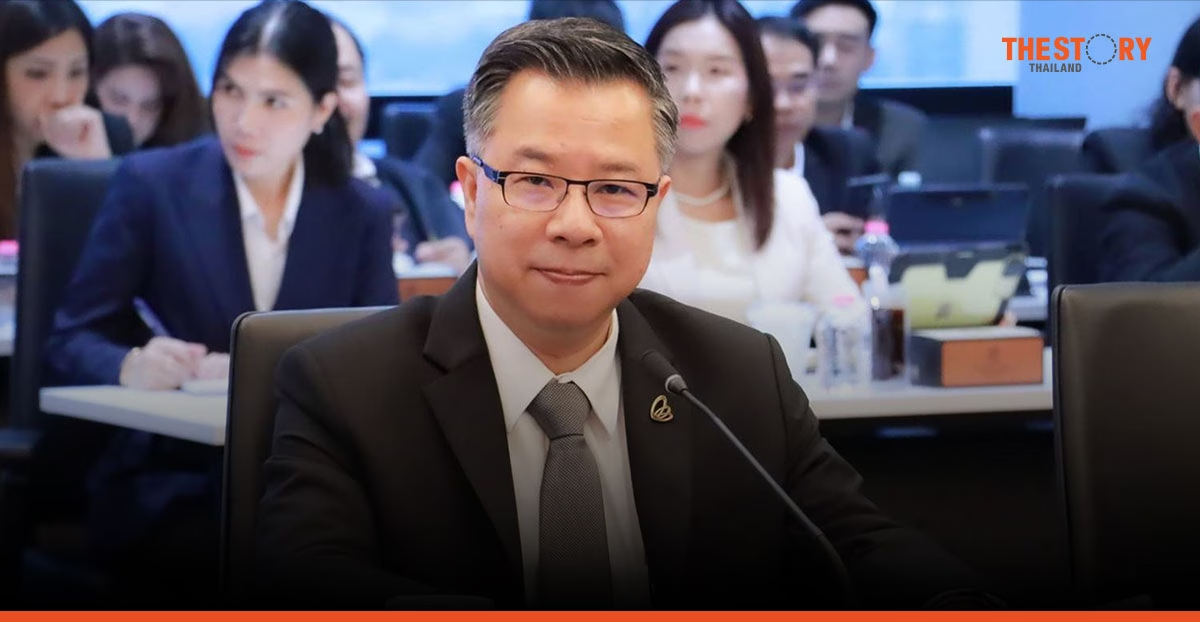
Narit Therdsteerasukdi, Secretary General of the BOI and Secretary of the EV Board, stated that the transition must turn rapid consumer demand into long-term capital formation, localized technology, and quality employment. He emphasized that the tax restructuring balances imports with domestic investment while maintaining a technology-open approach to solidify Thailand’s status as a global automotive production hub equipped for future technologies.
AI as a Supercar: Sigve Brekke urges Responsible AI to drive Thailand’s digital economy
KBank launches KBank Indonesia to tap rapidly growing 285M population market