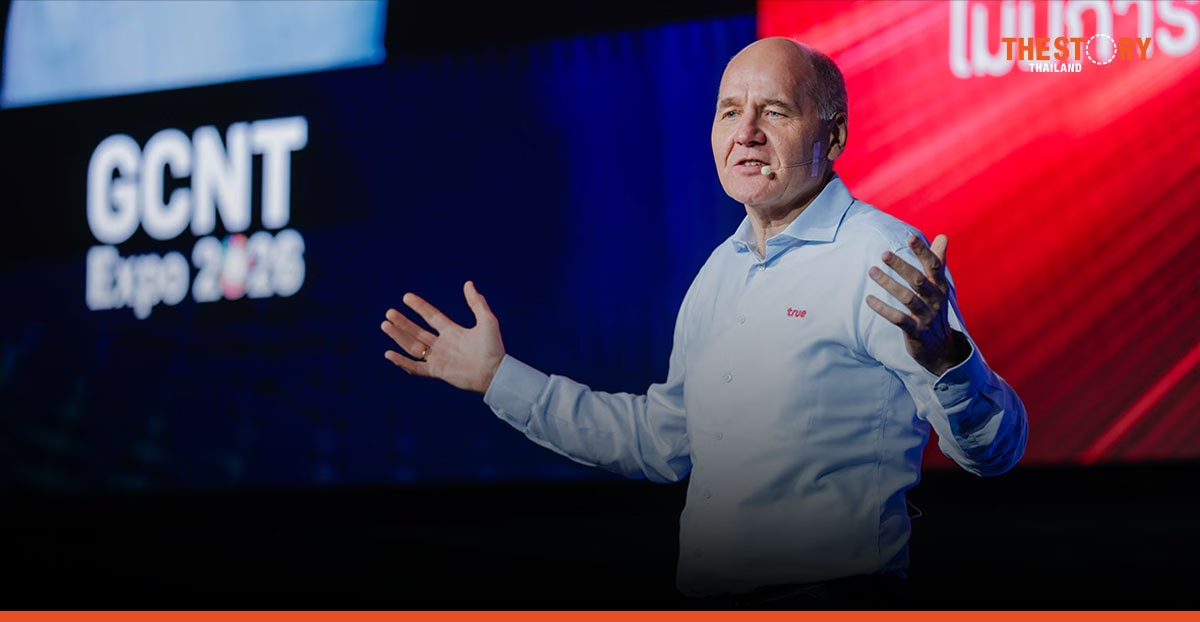
Sigve Brekke, Group CEO of True Corporation Plc., delivered a keynote address titled “From Algorithmic Shock to Ethical Shift: Why Trust Is the Currency of Thailand’s Digital Future” at GCNT EXPO 2026, held under the theme “FROM SHOCK TO SHIFT – Sustainable Transition in a Fractured World” organized by the Global Compact Network Thailand (GCNT) at True Digital Park. Brekke likened artificial intelligence to a high-powered supercar, emphasizing that Thailand must establish Responsible AI frameworks to convert public trust into a competitive advantage on the global stage.
Plummeting Costs Elevate AI into Core Infrastructure
Brekke noted that AI is rapidly transitioning from an experimental technology to essential infrastructure, driven by a dramatic collapse in operating costs. According to the Stanford AI Index, the cost of running a GPT-3.5-level model plummeted over 280-fold between late 2022 and 2024, supported by a 30% annual decline in hardware costs and a 40% leap in energy efficiency. These economic shifts have fueled record-breaking global uptake, with 4 billion adults—nearly half the global population—now using AI monthly. Furthermore, Generative AI reached 53% adoption within just three years, scaling 1.8 times faster than the internet and 2.7 times faster than the personal computer at equivalent post-launch stages.
Bridging the ‘Accountability Gap’
While corporate focus a year ago centered on deployment speed, Brekke highlighted a decisive shift toward governance and stewardship. The delegation of tasks to automated systems—ranging from content generation to autonomous decision-making—has created an “accountability gap,” raising critical questions about system overrides, error detection, and liability. Data from a 2025 survey of over 48,000 respondents across 47 countries by the University of Melbourne and KPMG revealed that while 66% of people use AI regularly, only 46% trust its outputs. Conversely, Thailand displays high public enthusiasm, with 77% telling the Stanford AI Index that AI yields more benefits than harms.
“Judgment is one of the critical scarce resources of this decade. Judgment is what frames the problem, defines success, and sets boundaries. Judgment requires real accountability—knowing exactly who can hit the brakes or change course.” — Sigve Brekke
OECD Findings Highlight Global Gaps; True Unveils Internal Framework
Addressing global policy implementation, Brekke cited the OECD’s 2026 Digital Government Outlook across 36 member countries. Although nearly all members adopted basic guardrails, only 39% mandate pre-deployment risk assessments, 31% conduct post-deployment audits, and just 22% offer public recourse or complaint mechanisms.
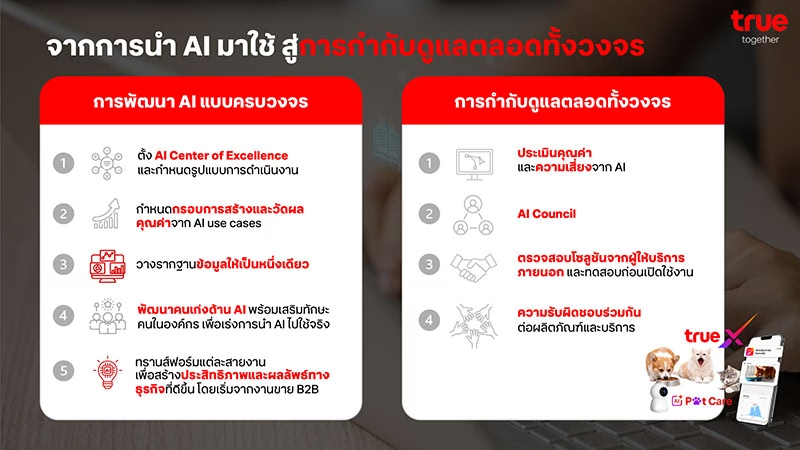
To bridge this governance gap internally, True Corporation implemented an end-to-end Responsible AI lifecycle embedded directly into its corporate Code of Conduct. Key measures include:
- Automated Risk Screening: A seven-question screening automatically flags any project handling personal data or impacting large populations as “high risk.”
- Executive Oversight via AI Council: High-risk projects undergo mandatory review by a standing AI Council chaired by senior leadership alongside privacy and security heads.
- Rigorous Technical Benchmarks: Generative AI models applied to consequential use cases must achieve up to 99% accuracy prior to launch, paired with mandatory human oversight.
- Third-Party Vendor Accountability: Because roughly 70% of True’s AI solutions are developed with external partners, vendors must prove data sovereignty and verify data accuracy as a strict business prerequisite.
Expanding Regulatory Sandboxes to Support National AI Strategy
Under Thailand’s National AI Strategy, the nation aims to train over 30,000 AI professionals, drive adoption across at least 600 organizations, and generate 48 billion baht in business and social value by 2027. To realize these goals safely, Brekke advocated for controlled regulatory sandboxes where government, industry, and technical experts can evaluate real-world AI use cases, gather empirical evidence, and refine safeguards before full-scale deployment.
“AI gives us speed. Governance gives us direction. Accountability earns us trust. And trust will be the currency of Thailand’s digital future.” — Sigve Brekke
Temus invests in Thinking Machines to scale enterprise AI across Southeast Asia
AIS partners with 5 Government agencies hosts AIS ACADEMY For THAIs 2026
SYNNEX-AWS launch AI Hub to accelerate enterprise AI adoption in Thailand