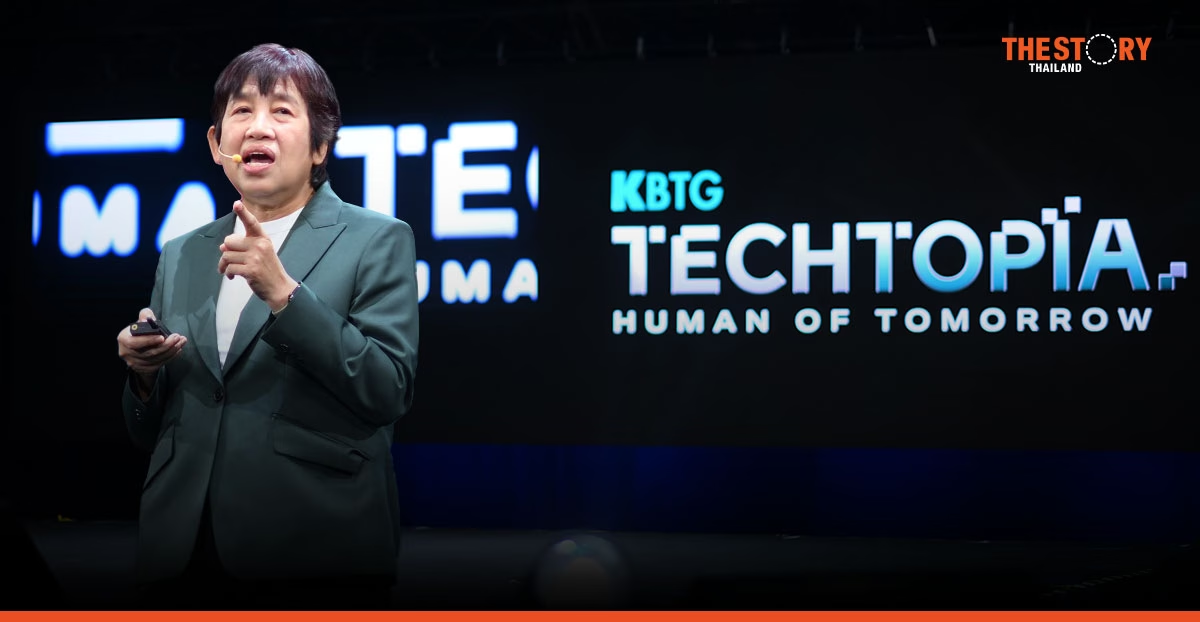
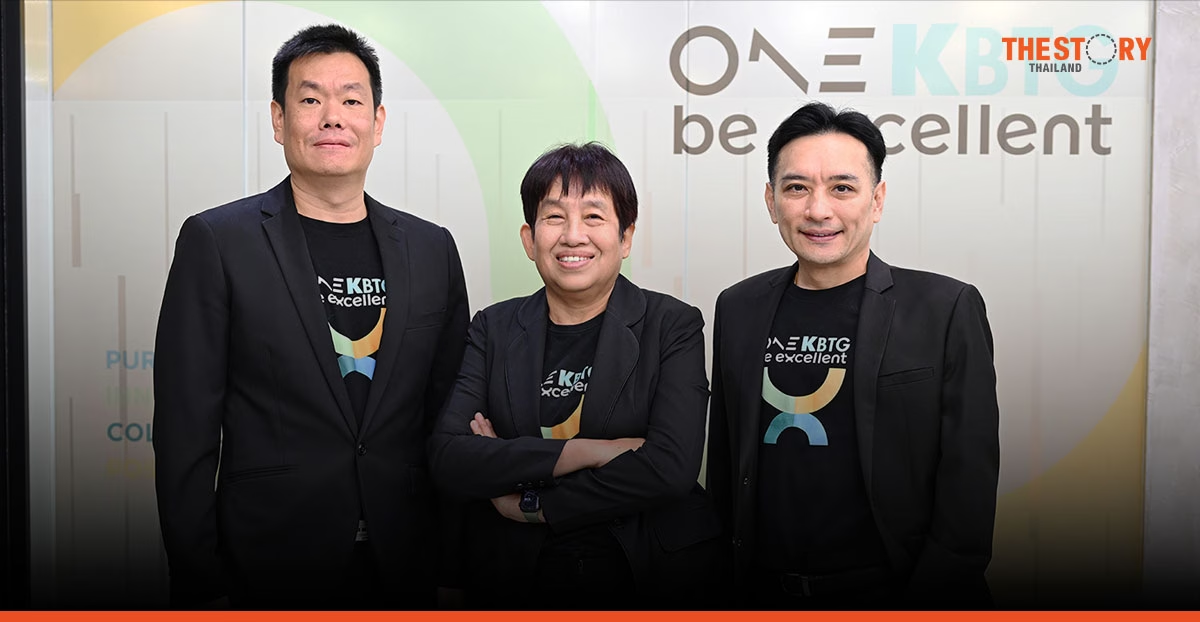
Kasikorn Business-Technology Group (KBTG), the technology arm of Thailand’s Kasikornbank (KBank), has announced a strategic shift entering its second decade, moving from experimental artificial intelligence deployments to driving measurable business returns across its regional operations.
Under its new directive, “The Next Chapter of Financial Services: AI, Data & Regional Growth,” the company aims to become a “Regional AI Infused Powerhouse.” The strategy focuses on embedding AI into its massive financial infrastructure, which serves 24.5 million K PLUS digital banking users, over 4 million MAKE by KBank app users, 600,000 MeowJot application users, and roughly 30 million AINU identity verification platform customers.
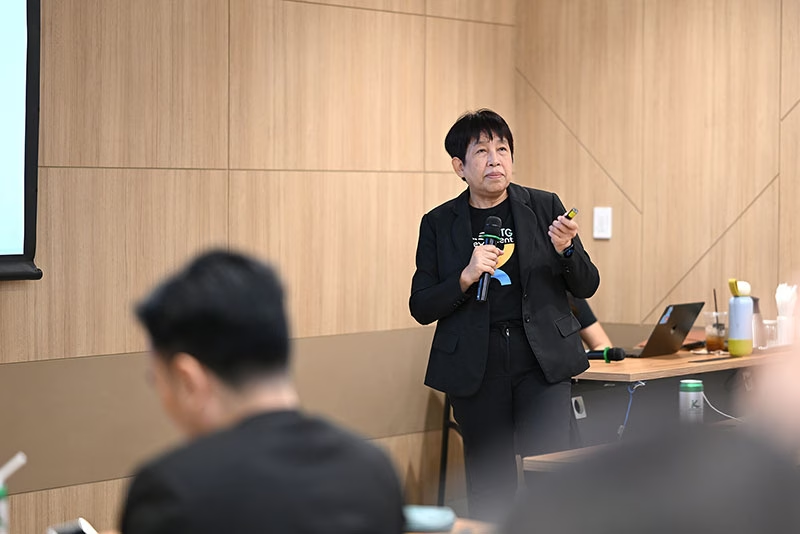
Voranuch Dejakaisaya, executive chairman of KBTG, stated that operationalizing the technology immediately impacts profit-and-loss statements as expenses once active. “AI is not an expense; AI is an investment,” she noted. “The day you press start on AI, it becomes an expense.”
Proving AI’s Business Value
Following an intensive period of AI training and pilot testing from 2024 to 2025, KBTG is dedicating 2026 to full-scale scaling and optimization. The organization is embedding AI across all operational nodes, including software development, IT operations, infrastructure, and cybersecurity.
The strategy comes amid rapid adoption rates. AI dissemination in Thailand grew by 36.4% from the first quarter of 2025 to the first quarter of 2026, marking the second-fastest growth rate globally.
Despite high adoption rates worldwide, KBTG highlighted global statistics showing that 95% of Generative AI projects fail to yield tangible business results, and only about 30% of developed AI models successfully scale at an enterprise level. Consequently, KBTG’s objective is focused on converting AI into measurable outcomes: reducing costs, enhancing efficiency, mitigating risks, generating revenue, and improving customer experience.
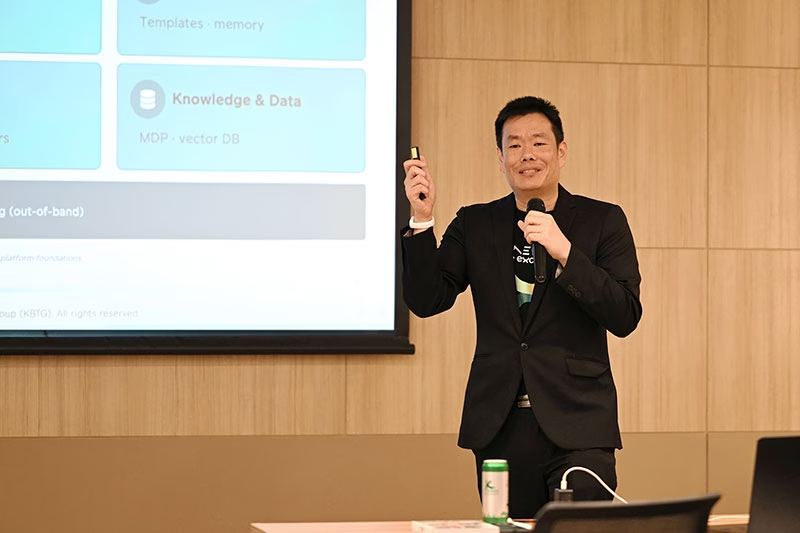
Thadpong Pongthawornkamol, managing Director of KBTG, stated that evaluating AI return on investment (ROI) extends beyond direct revenue or cost metrics. Value can manifest in conversion rates, lowered loan default risks, higher document processing quality, increased process speeds, or elevated customer satisfaction.
To evaluate these diverse impacts, KBTG has implemented a “9-Box” AI ROI measurement framework to tie individual use cases directly to broader corporate performance metrics. Instead of focusing strictly on direct financial returns, this matrix evaluates how AI generates value across multiple dimensions, including internal processes, customer experience, risk mitigation, and overall organizational efficiency.
For example, KBTG uses the framework to track back-office cost reductions, spending and rewards management, and document processing quality checks. It also measures the impact of AINU—its identity verification platform that serves approximately 30 million users and has been adopted by over 30 corporate clients internationally.
The company currently has more than 80 AI use cases outlined in its operational pipeline, all required to demonstrate clear core value metrics under this framework before deployment.
Software Development and AI Agents
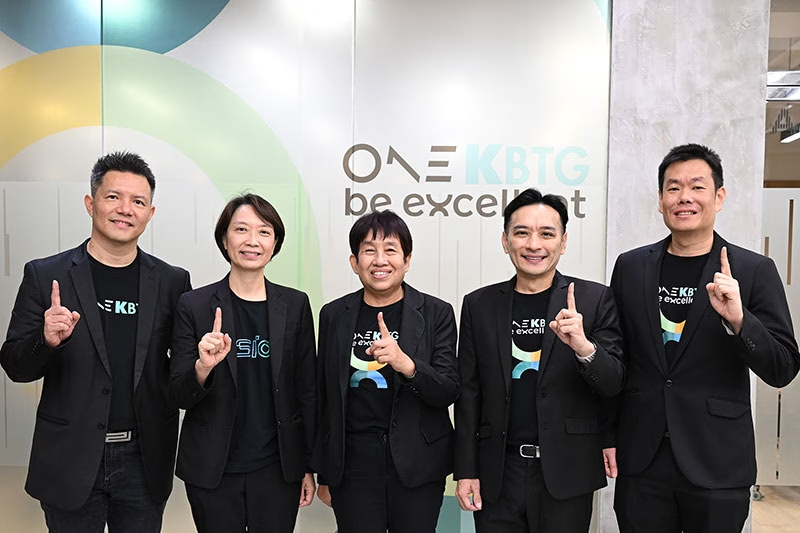
Among KBTG’s primary operational milestones is the optimization of its software engineering division. In 2025, the company used coding assistants to boost IT work efficiency by approximately 8%, yielding 30 million baht in cost savings.
This year, the company transitioned to utilizing agentic AI to support end-to-end software lifecycles.
“KBTG did not stop at using AI just for code generation,” said Charassri Phaholyotin, vice chairman of KBTG. “We have created 10 AI Agents to work collaboratively throughout the software development process, covering requirements gathering, design, system architecture, and testing.”
As a result, AI-generated code at KBTG surged from 21 million lines last year to 41 million lines within the first five months of 2026, representing roughly 15% of the total volume written by the organization’s human engineers. KBTG aims to leverage AI to improve overall IT delivery efficiency by 15% within the year, with higher efficiency targets set for subsequent phases.
Core Business Integration
KBTG is expanding these technical efficiencies into KBank’s core commercial units, prioritizing credit lending, marketing, customer service, and back-office operations.
In lending, AI is being woven into the application funnel across both online channels and physical branches, as well as the pre-approval phase, to evaluate improvements in processing speed, accuracy, decision-making quality, throughput, and customer satisfaction.
For customer services, AI is deployed to synthesize voice conversations at customer service centers. While supervisors previously relied on random audio sampling to evaluate service quality, AI now analyzes and flags issues across a much broader pool of customer interactions.
Structure and Governance: The 5+P Strategy
To operationalize AI at scale, KBTG has deployed an “AI 5+P” strategy centered on human capital. The framework covers five primary domains:
- AI for Banking Business
- AI for IT Delivery and Operations
- AI Platform and Governance
- Co-Innovation and Ecosystem Partnerships
- AI-Driven Innovation Products
- Value creation is guided by the formula
- V=(P+P+P)E
where V represents tangible value, the three P variables stand for Process, People, and Platform, and E represents Experimentation, learning, and scaling.
Concurrently, KBTG is overhauling its legacy systems to improve flexibility and support enterprise-wide scaling while minimizing application deployment disruptions and accelerating issue detection. The firm is also prioritizing in-house technology development to mitigate risks associated with relying heavily on third-party vendors, such as escalating costs, business continuity issues, geopolitical factors, and technological dependency.
Cybersecurity and Post-Quantum Planning
As AI becomes central to banking operations, KBTG is intensifying its focus on digital trust and cybersecurity under a “Responsible AI” policy that mandates strict technical security, ethics, privacy, transparency, fairness, and bias reduction.
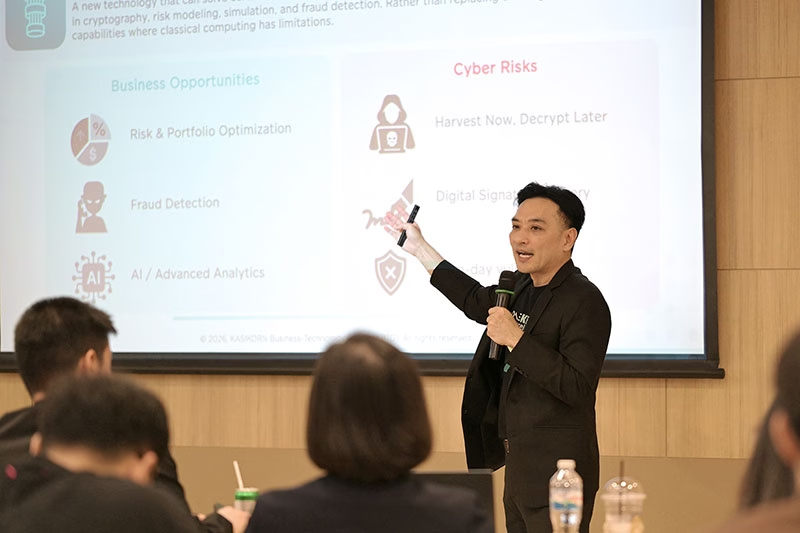
Chatchawat Asawarakwong, vice chairman & Group CISO, stated that the organization approaches AI security from two perspectives. The first involves securing AI development and usage through gateways, data leakage prevention, and AI Red Teaming. The second leverages AI to enhance cybersecurity defenses, such as automated risk assessments and vulnerability detection, to counter sophisticated threats like deepfakes, phishing, ransomware, and third-party risks.
Looking further ahead, KBTG is preparing for the security implications of quantum computing, which industry projections suggest could disrupt traditional asymmetric (two-key) encryption methods by 2030, reducing decryption timelines from years to minutes.
Unlike the Y2K bug, quantum threats lack a fixed calendar deadline, making planning highly complex. In response, KBTG is collaborating with Thailand’s national cyber agencies and banks to migrate critical infrastructures to Post-Quantum Cryptography (PQC) by 2029, ahead of the projected 2030 threshold.
A primary focus of this migration is establishing “Crypto Agility”—building systems capable of swapping encryption algorithms rapidly as older methods become obsolete. KBTG is currently auditing and cataloging all encrypted systems, applications, and hardware devices to map the required upgrades.
Human-First Architecture
Despite its aggressive push toward becoming an AI-first technology organization, KBTG maintains that human capital remains the foundation of its enterprise strategy.
According to Executive Chairman Voranuch, integrating AI is not designed to replace staff or downsize the workforce. Instead, it aims to restructure end-to-end workflows so that humans retain ultimate responsibility, upgrade their skill sets, and utilize AI to oversee overall operational efficiency.
KBTG has mandated AI training for all KBank employees and has completed two cohorts of its Cyber Bootcamp to upgrade cybersecurity competencies among Thai IT professionals. The company stated that long-term innovation capabilities remain tied to holistic employee upskilling, workplace ecosystem readiness, and staff well-being.